
Refpo Article
How to Become a Self-Taught Millionaire Legitimately — Using Just Your PC and the Internet
Becoming a millionaire through the internet sounds like something that belongs in a motivational video. But the internet has genuinely created opportunities that were difficult or impossible for individuals to access a few decades ago. You can now build a website, launch software, create a YouTube channel, sell products, develop an audience, or build a referral business — all from a computer. However, there is an important distinction:
Making money online is possible. Becoming a millionaire is possible. Becoming one quickly and reliably is not guaranteed.
The objective should therefore not be to find a "secret trick." Instead, build skills → audience/users → revenue → systems → assets → reinvestment. This guide ranks several legitimate online models, beginning with the methods discussed most frequently by aspiring online entrepreneurs.
Before You Start: What Does "Millionaire" Mean?
In this article, millionaire means reaching a net worth of at least ₹10 lakh or, in the broader international sense, approximately US$1 million. Those are very different targets. If your goal is ₹10 lakh, a profitable side business or online career can potentially get you there. If your goal is ₹1 crore+, you generally need a scalable business, substantial investments, or a combination of multiple income-producing assets. And if you mean US$1 million, the challenge is substantially larger. The important lesson is:
Don't chase a number first. Build an asset that can keep producing value.
🥇 1. Crypto Trading & Investing
Crypto is one of the most accessible financial markets from a computer. You can create an account, deposit INR, purchase cryptocurrency and manage your portfolio completely online. But this is also the highest-risk method on this list. It should not be confused with a guaranteed path to wealth.
Trading vs Investing
There are two fundamentally different approaches.
Crypto Investing
You purchase an asset and hold it for a longer period. The basic concept is:
Research → Buy → Hold → Manage risk → Sell according to your strategy.
Crypto Trading
Trading attempts to profit from shorter-term price movements.
Market analysis → Entry → Position management → Exit → Profit/Loss
Trading requires considerably more knowledge of:
- Technical analysis
- Market structure
- Position sizing
- Risk management
- Liquidity
- Volatility
- Trading psychology
- Taxes
- Exchange fees
Don't Start With Leverage
One of the biggest mistakes beginners make is assuming:
"If 10% movement gives me 10% profit, leverage will make me rich faster."
Leverage magnifies losses as well as gains and can liquidate positions. For someone learning, understanding spot markets and risk management should come before leveraged trading.
Crypto Platforms to Research in India
There is no universally "best" exchange for everyone. Fees, supported assets, INR deposits/withdrawals, security features and trading products can change. Examples worth researching include:
- CoinDCX
CoinDCX publishes different fee tiers depending on trading volume and product. Its current published regular INR spot tier shows 0.50% for the lowest volume tier, with lower rates at higher volumes.
- Mudrex
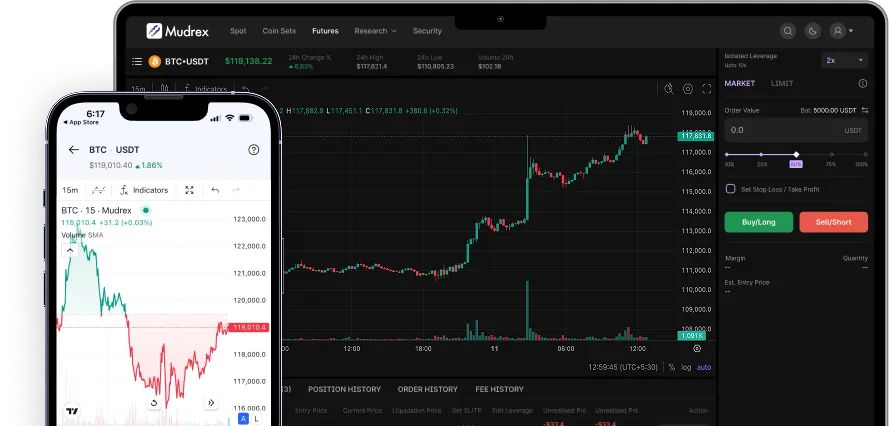
Mudrex currently publishes 0% INR deposit and INR withdrawal fees and an INR spot trading fee beginning at 0.45% for its lowest tier. Its published fee schedule also explains applicable TDS and GST.
- CoinSwitch
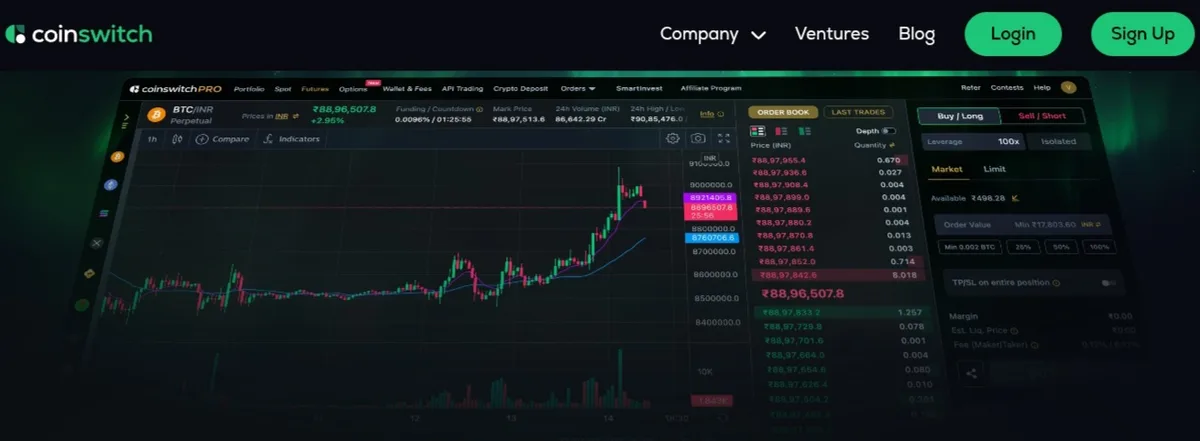
CoinSwitch is another Indian crypto platform that can be compared when evaluating INR-based crypto access.
What Should You Compare?
Don't choose an exchange simply because an influencer calls it "best." Compare:
- Trading fees
- INR deposit methods
- INR withdrawal fees
- Crypto withdrawal fees
- Available cryptocurrencies
- Security features
- Account protection
- Liquidity
- Tax reporting/support
- Customer support
- Whether the specific product you want is available
The Millionaire Mathematics
Suppose someone starts with: ₹1,00,000 Even an extraordinary hypothetical 100% return only turns it into: ₹2,00,000 To turn ₹1 lakh into ₹1 crore purely through repeated 100% gains would require an enormous sequence of successful trades. That's why starting capital alone is not a wealth strategy. A more sustainable approach is:
Earn actively + invest intelligently + build scalable businesses.
Crypto can potentially be one component of that strategy rather than the entire strategy.
🥈 2. Build a Website Around a Unique Niche
This is one of the most interesting opportunities for someone with only a computer. You don't necessarily need a huge company. You need:
A problem → useful solution → search/audience demand → monetization.
For example:
- Calculators
- Educational resources
- Comparison websites
- AI utilities
- Student tools
- Finance calculators
- Productivity tools
- Travel tools
- Local information
- Templates
- Generators
- Online utilities
- Specialized databases
The Niche Formula
Instead of:
"I want to make a website."
Think:
"What problem do thousands or millions of people repeatedly have?"
Then build the simplest useful solution.
Example
Instead of:
"I will create a technology blog."
Try:
"I will create a website that helps students calculate and understand X."
Or:
"I will create a tool that converts X into Y."
Or:
"I will build a searchable database for X."
The second approach can create something much more useful than another generic blog.
How Websites Make Money
A successful website can have several revenue streams.
- AdSense
- Affiliate commissions
- Premium tools
- Subscriptions
- Sponsorships
- Digital products
- Lead generation
Google AdSense
Google requires publishers to have original, high-quality content that attracts an audience and complies with its policies. That means simply generating thousands of low-quality AI articles and hoping for advertising revenue is not a reliable strategy. Google specifically emphasizes unique, useful content and warns against sites that provide little additional value.
The Website Flywheel
A strong website can follow this model:
Find problem → Build solution → SEO / Social Media → Traffic → Ads + Affiliate + Product → Revenue → Reinvest → More tools/content → More traffic→ More revenue
The biggest advantage? A website can continue receiving visitors even when you're not actively working on it. That makes it an online asset rather than simply another job.
🥉 3. YouTube + Social Media
You don't necessarily need an expensive camera. A PC, microphone, editing software and creativity can be enough. You can build content around:
- Education
- Technology
- Gaming
- Finance
- Productivity
- AI
- Tutorials
- Entertainment
- Reviews
- News/commentary
- Stories
- Animation
- Short-form comedy
YouTube's Multiple Revenue Streams
YouTube can potentially generate revenue through:
- Advertising
- Channel memberships
- Super Chat
- Sponsorships
- Affiliate marketing
- Product sales
- Digital products
- Brand partnerships
- Creator partnerships
YouTube's Partner Programme provides access to monetization features after meeting the relevant eligibility requirements and passing review. For the currently published full YPP advertising threshold, YouTube lists 1,000 subscribers plus either 4,000 valid public watch hours in the previous 12 months or 10 million valid public Shorts views in 90 days. YouTube has also announced changes beginning February 1, 2027, so creators should check the current requirements in YouTube Studio rather than relying on old tutorials.
Don't Build Only for Ad Revenue
A creator with 100,000 followers might make money from: Audience
This is significantly more powerful than depending on advertisements alone.
- Ads
- Affiliate links
- Sponsorships
- Website
- Digital products
- Own business
4. Sell Products Through Amazon or Your Own E-Commerce Store
E-commerce allows you to sell physical products without owning a traditional retail shop. Potential models include:
- Private label
- Handmade products
- Customized products
- Wholesale
- Manufacturing
- Print-on-demand
- Specialized niche products
Amazon India
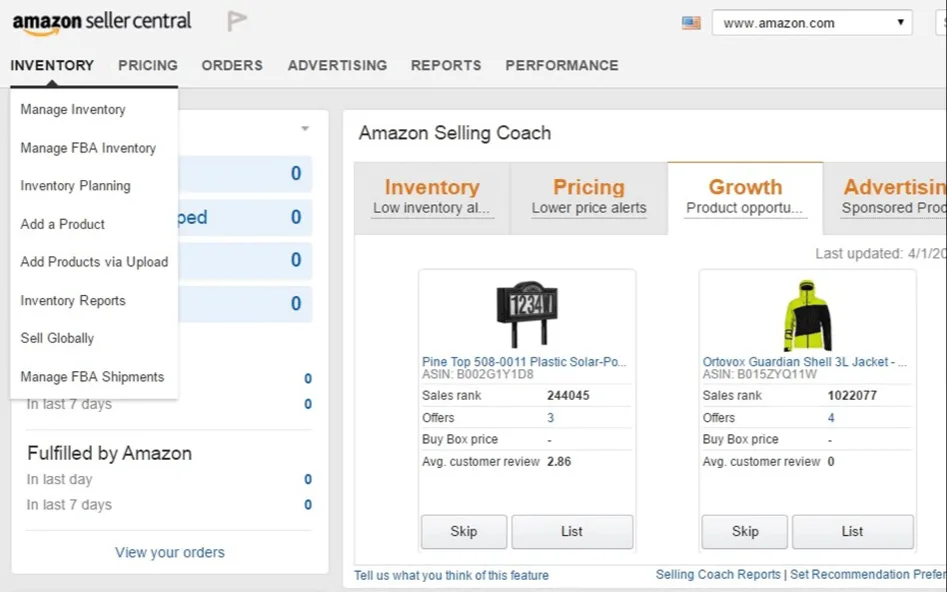
Amazon Seller Central India Amazon's current seller information says that sellers can register, provide required information such as GST details where applicable, add products and choose fulfillment methods.
Amazon announced in March 2026 that referral fees were reduced to zero for eligible products under ₹1,000 across more than 1,800 categories, with the revised fees effective March 16, 2026. Other fees can still apply.
Therefore, never calculate profitability using only the product purchase price and selling price. Consider: Selling price
- Product cost
- Marketplace fees
- Shipping
- Packaging
- Returns
- Taxes
- Advertising
- Payment-related costs
= Actual profit
5. Build Online Tools, Platforms or SaaS
This is one of the most scalable models available to a technically capable person. Imagine building something that solves one small problem. For example:
The key is not to build a gigantic platform immediately. Start with:
- PDF utility
- Image converter
- AI research tool
- Resume generator
- Invoice generator
- Student calculator
- Business calculator
- SEO tool
- Social media tool
- Productivity application
- Data analysis tool
One problem. One solution. One audience.
The SaaS Model
Build tool →Free users →Traffic →Free plan →Premium features →Monthly subscription →Recurring revenue
Suppose a tool eventually gets:
10,000 users
and only:
2% become paying customers
That's:
200 customers
At ₹500/month:
₹1,00,000/month recurring revenue
This is only an illustration, not a forecast. Actual conversion rates can be much lower or higher depending on the product, audience and pricing.
6. Referral Marketing
Referral marketing is another model that can be started with very little capital. The basic concept is:
Person discovers product→ Uses referral→Valid action occurs→Business gets a customer/user→Referrer receives reward
The important part is value exchange. Companies are willing to spend money acquiring customers. Instead of spending the entire customer-acquisition budget on traditional advertising, a company can reward people who generate legitimate referrals.
Refpo's Approach to Referral Marketing
Refpo Platforms such as Refpo can explore a model where users discover referral opportunities, add valid referrals and potentially earn rewards based on qualifying actions. The important principle is:
A legitimate referral should create genuine value for the business and the referred user.
That means avoiding:
- Fake accounts
- Self-referrals where prohibited
- Spam
- Automated fraudulent activity
- Misleading claims
- Manipulated transactions
Referral marketing becomes much more powerful when it is connected to useful products rather than treated as a "click and earn" scheme.
7. Freelancing
Freelancing is probably one of the easiest ways to turn a PC into an income-producing asset. You can sell skills such as:
Platforms can include:
The downside is that freelancing initially exchanges time for money. The goal should eventually be: Freelancer→ Specialist→Premium service→ Repeat clients→ Agency/system→ Product/SaaS That's where the model becomes more scalable.
- Web development
- Graphic design
- Video editing
- Thumbnail design
- SEO
- Content writing
- Programming
- AI automation
- Data analysis
- Presentation design
- Digital marketing
- Virtual assistance
- Upwork
- Fiverr
- Freelancer
- Toptal
- Direct client acquisition
8. Digital Products
One of the most underrated online businesses is selling something that can be created once and delivered repeatedly. Examples:
- E-books
- Templates
- Notion templates
- Excel spreadsheets
- Design assets
- Presets
- Study notes
- Courses
- Coding components
- Business documents
- Prompt collections
- Educational resources
The economics can be attractive because there is little or no physical inventory. For example: Create product: ₹10,000 effort
Sell: 100 × ₹499 = ₹49,900 Again, this is an illustration rather than a guaranteed result.
9. Affiliate Marketing
Affiliate marketing is similar to referral marketing, but the monetization mechanism is usually a commission from qualifying purchases or actions. For example: You create useful content → User reads/watch it → User clicks your affiliate link → User purchases → You receive commission
Amazon Associates is one example. Amazon says its programme allows creators, publishers and bloggers to monetize traffic through qualifying purchases, with advertised commission rates varying by programme/category.
The biggest mistake is creating a website filled with random affiliate links. Instead:
Create useful content first. Monetize the audience second.
10. Build an Online Agency
Once you become good at one digital skill, you can turn it into a business. For example:
Video Editing
You edit videos → Get 3 clients → Get 10 clients → Hire editors → You manage clients → Agency
The same principle works for:
- Web development
- SEO
- Social media management
- Graphic design
- AI automation
- Advertising
- Content production
The transformation is: Skill → Service → System → Team → Business
The Most Powerful Strategy: Combine Multiple Models
You don't have to choose only one. In fact, online businesses often become much stronger when different models support each other.
The "PC Millionaire" Flywheel
If you are starting with almost no capital, consider building in this sequence:
Stage 1 — Learn
Learn one valuable skill.
- Programming
- Design
- Video
- SEO
- Marketing
- Writing
- AI
- Sales
Stage 2 — Earn
Use the skill to generate your first ₹1,000.
Then ₹10,000.
Then ₹50,000.
Stage 3 — Build
Use your experience to create an asset:
- Website
- Tool
- YouTube channel
- Product
- Newsletter
- SaaS
- Community
Stage 4 — Monetize
Add:
- Advertising
- Affiliate revenue
- Subscription
- Referral revenue
- Sponsorship
- Product sales
Stage 5 — Scale
Reinvest the money into:
- Better infrastructure
- Content
- Marketing
- Development
- Automation
- Customer acquisition
Stage 6 — Invest
Once cash flow becomes consistent, some profits can potentially be diversified into suitable long-term investments rather than continuously reinvesting everything into the same business.
A ₹0-to-₹1 Crore Framework
Instead of thinking:
"How can I make ₹1 crore?"
Break it into milestones.
₹0 → Learn a valuable skill
₹1,000 → Prove someone will pay
₹10,000→ Find repeatable demand
₹50,000→ Establish a reliable income stream
₹1 lakh → Build systems
₹5 lakh → Create scalable assets
₹10 lakh → Diversify
₹50 lakh → Scale businesses/assets
₹1 crore → Build sustainable wealth
The first ₹1,000 can actually be more important psychologically than dreaming about ₹1 crore. It proves:
Someone is willing to pay for the value you create.
What You Should NOT Do
The internet contains thousands of "get rich quick" schemes.
Be extremely cautious about:
- Guaranteed crypto profits
- Paid signal groups promising certainty
- Fake investment schemes
- Ponzi schemes
- Fake mining platforms
- "Double your money" offers
- Fake affiliate programmes
- Account-selling schemes
- Copyright infringement businesses
- Fake reviews
- Spam-based referral systems
- Ad-click manipulation
- Fake traffic
- Bot-generated engagement
- Pyramid schemes disguised as businesses
In particular, don't attempt to manipulate advertising systems.
Google's publisher policies prohibit activities that artificially inflate clicks or impressions and can result in ad serving being restricted or accounts being disabled.
The Real Secret Isn't the Internet
The internet isn't the business. The internet is the distribution system.
Your real assets are:
1. Skills
What can you do?
2. Attention
How many people can you reach?
3. Trust
Do people believe your recommendations?
4. Technology
Can you build something useful?
5. Distribution
Can you reach users without paying huge amounts?
6. Systems
Can the business continue working without every task requiring your personal time?
A Practical 12-Month Plan
Months 1–2: Learn Choose one primary skill. Don't attempt to learn:
coding + trading + YouTube + SEO + e-commerce + AI + graphic design
simultaneously. Choose one.
Months 3–4: Build Create your first:
Don't wait for perfection.
- Website
- Tool
- Channel
- Service
- Product
- Store
Months 5–6: Find Users Focus on distribution:
- SEO
- YouTube
- Reddit where appropriate
- Communities
- Search
- Partnerships
- Referral systems
Months 7–9: Monetize Introduce appropriate monetization:
Free audience →Useful content/product → Trust→Monetization
Months 10–12: Scale Identify what works. Then do more of it. Automate repetitive work. Improve conversion. Build additional revenue streams.
The Golden Rule
Don't try to become rich by finding something that makes money.
Try to become valuable by building something that helps people.
The money can then become a consequence of:
Value × Distribution × Scale × Time
A person with a PC can now potentially reach customers across India — or across the world — without owning a physical shop.
But the same internet that creates opportunities also creates competition.
So the winning mindset isn't:
"How quickly can I become a millionaire?"
It is:
"What valuable thing can I build today that can still produce value five years from now?"
Final Takeaway
There are legitimate ways to build substantial wealth online using only a computer.
The major paths include:
- Crypto investing/trading — potentially high returns but extremely high risk.
- Niche websites — content, tools and advertising.
- YouTube/social media — audience plus multiple monetization channels.
- E-commerce — sell physical products online.
- SaaS/tools — build software that solves a specific problem.
- Referral marketing — connect businesses, users and legitimate rewards.
- Freelancing — monetize valuable skills.
- Digital products — create once and sell repeatedly.
- Affiliate marketing — monetize trusted recommendations.
- Online agencies — turn skills into scalable businesses.
The most important idea is that you don't necessarily need to pick just one forever.
You can start with a skill, use that skill to generate income, use the income to build an online asset, use the asset to build an audience, and then use that audience to create additional businesses.
SKILL → INCOME → ASSET → AUDIENCE → MONETIZATION → SCALE → WEALTH
The PC is only the starting point.
The real wealth-building asset is what you create with it.
Quick Comparison
Quick Comparison Table
Ranked Online Ways to Build Wealth
| Rank | Method | Starting cost | Difficulty | Scalability | Main Risk |
|---|---|---|---|---|---|
| 1 |  Crypto trading/investingLow–Medium Crypto trading/investingLow–Medium | Low–Medium | Very High | High | Capital loss |
| 2 |  Website + niche + advertisingLow Website + niche + advertisingLow | Low | Medium–High | Very High | Traffic dependency |
| 3 |  YouTube & social mediaVery Low YouTube & social mediaVery Low | Very Low | Medium–High | Very High | Audience dependency |
| 4 |  E-commerce / AmazonMedium E-commerce / AmazonMedium | Medium | Medium–High | High | Inventory & margins |
| 5 |  Online tools / SaaSLow–Medium Online tools / SaaSLow–Medium | Low–Medium | High | Extremely High | Product failure |
| 6 |  Referral marketingVery Low Referral marketingVery Low | Very Low | Medium | High | Trust & conversion |
| 7 |  Freelancing & digital servicesVery Low Freelancing & digital servicesVery Low | Very Low | Medium | Medium | Time dependency |
| 8 |  Digital products & coursesVery Low Digital products & coursesVery Low | Very Low | Medium | High | Audience & competition |
| 9 |  Affiliate marketingVery Low Affiliate marketingVery Low | Very Low | Medium | High | Traffic/conversion |
| 10 |  Remote online business/agencyLow Remote online business/agencyLow | Low | High | High | Client acquisition |
Data according to the author.
Community Comments
Comments (0)
Add Comment
800 characters left
Loading comments...
Previous Post
Best Cashback Apps for Credit Card Users in India 2026
Next Post
Best FD Backed Credit Cards Without Income Proof in India (2026)
Related
More Refpo reads

Top Invite-Only Credit Cards in India (2026): Benefits, Fees & How to Get Invited
Discover the top invite-only credit cards in India for 2026, featuring premium options like HDFC Infinia and ICICI Emeralde Private Metal. Explore their exclusive benefits, fees, rewards, eligibility criteria, and practical tips to improve your chances of receiving an invitation.
Best Zero-Balance Digital Savings Accounts for Students in India (2026)
Looking for a zero-balance savings account as a student in India? Explore the best digital savings accounts for 2026, comparing minimum balance requirements, banking features, eligibility, fees, and investment options to find the right account for your needs.
Best Zero Balance Savings Accounts in Top Private Banks in India (2026)
Looking for the best zero-balance savings account in India? Compare Kotak 811, IDFC FIRST Quantum+, Axis AMAZE, AU Small Finance Bank, ICICI Bank, and HDFC Bank based on features, charges, and benefits.
People Also Looking For
How to Become a Self-Taught Millionaire Legitimately — Using Just Your PC and the Internet / Top Invite-Only Credit Cards in India (2026): Benefits, Fees & How to Get Invited / Best Zero-Balance Digital Savings Accounts for Students in India (2026) / Best Credit Card Offers for Diwali Shopping 2026: Amazon, Flipkart & More / Best Cashback Apps for Credit Card Users in India 2026 / How to Earn Small Side Income Using Referral Apps / Best Referral Apps for College Students in India (2026) / Best Zero Balance Savings Accounts in Top Private Banks in India (2026)
More Ways to Earn Money Online
Step-by-Step Upstox Account Opening With Referral Code (2026 Guide) / Amazon Pay Referral Reward Not Credited? Fixes Explained (2026 Guide) / BHIM Referral Code Not Working? Fixes Explained / Best FD Backed Credit Cards Without Income Proof in India (2026) / IDFC FIRST Bank Refer and Earn / airbnb Refer and Earn / Win money Refer and Earn / Magicpin Refer and Earn